
Veronika Weithaler
January 2018 – March 2018
Designing a Global Digital Experience for the Weithaler Method
Pelvic floor dysfunction, prolapse, and incontinence affect many people, yet accessible and easy-to-understand educational and therapy resources remain limited.
This story is about how I helped pelvic floor therapist Veronika Weithaler create a strong online presence, with the aim of making a positive difference in the lives of people suffering from pelvic floor dysfunction through her courses, consultations, and therapy sessions.
I designed and launched a multilingual CMS website to serve her international clientele in Italian, German, and English.
All the information in this case study is my own and does not reflect the views of the client (Veronika Weithaler)

Context
Overview | Who is Veronika, and what is Weithaler method
Veronika Weithaler is a pelvic health therapist based in Italy, who has developed an innovative therapeutic approach focused on improving the quality of life for people experiencing pelvic floor dysfunction, prolapse, and incontinence. Her work combines education, guided exercises, and therapy programs that help individuals better understand and care for their pelvic health.
The goal
This project aimed to translate Veronika’s unique method into a digital platform that is accessible, educational, and supportive for users. Through a thoughtful UI/UX process, the goal was to design a website that builds trust, presents complex health information clearly, encourage users to access the course information and book links, while guiding users through her approach in a way that feels personal and empowering.
My role
I led this project as a design-to-development endeavor for a multi-lingual website. My responsibilities included conducting research, strategic planning, visual design, and a responsive web development. The content was curated by the therapist herself in three languages – Italian, English, and German.
Timeline
The duration of the project was 8 weeks. We had four creative reviews where the stakeholder Veronika Weithaler gave feedback and critiques, where we reviewed her business direction. I roughly had four weeks of total design time, as I had six days for the initial design development and then 2-3 days between reviews for edits.
Project Brief
Veronika Wiethaler had four primary objectives:
-
To effectively present and elaborate on her newly developed method
-
To showcase her individual, group, and professional courses in a clear and elegant way
-
To create a seamless web experience in three languages—Italian, English, and German
-
To attractively feature her published books related to the subject
Veronika’s previous website was built on the Weebly platform and lacked the clarity and visual simplicity she needed. She wanted a fresh, clean interface with a minimal aesthetic and a strong, distinctive colour to reflect the calm and focused nature of her therapy practice.
Constraints
I identified three main challenges in approaching this web solution.
- The New Method (Il Metodo Nuovo) : With over 15 years of experience, three published books, and numerous courses and workshops to her credit, Veronika had developed a groundbreaking, non-invasive method for alleviating pelvic floor pain. My challenge was to first understand the method and its application, and then communicate it in a way that inspires trust and conveys the method’s credibility.
- On-time for the Summer Courses: Veronika had several advanced and professional courses scheduled within a tight timeframe, spanning from March 2018 to June 2018. With a summer audience in mind, she was eager to showcase these courses on her new website. This urgency necessitated swift action on my part, with a primary focus on ensuring the website was up and running optimally within a compressed timeline.
-
Multi-lingual: Since the publication of her books in 2014, Veronika received an overwhelming response from her American audience. Originally from Germany and running a successful practice in Italy, she recognized the need to expand her reach globally while continuing to support her Italian clientele. Creating a multilingual website became the natural next step.
Designing the site in three languages presented unique challenges. Accommodating different word lengths, crafting intuitive multilingual navigation, and managing image classification, all of which required thoughtful problem-solving and adaptability.
The Research
Generative User Interviews
To frame the right digital narrative for Veronika’s pioneering pelvic floor therapy method, I began with generative user interviews aimed at uncovering deep insights in understanding the fundamentals of pelvic floor anatomy. Understanding, how Veronika’s method differs from traditional approaches.
I interviewed a mix of Veronika’s existing clients and therapy experts she collaborates with at training centers.
“I wanted to try the therapy,.. but I also needed clear guidance and background info. Articles and supportive resources made me trust the method more.”
-Interviewee/ Existing client
“Veronika’s method goes beyond exercises. Her use of breathing, movement, and visualization achieves remarkable results, even with severely restricted clients”
-Interviewee 02 / Fellow therapist
Synthesizing data and interview results:
These conversations challenged some of my early assumptions. While I initially believed users would focus mainly on the core benefits of Veronika’s technique, the insights showed that engagement with related therapies and educational resources played an equally important role. Users often relied on blogs, articles, and supportive communities to better understand their condition and feel more confident about seeking treatment.
I also explored how the unique needs and expectations of her target audience differs across the three key countries. While the Italian audience could meet her in person for the sessions, the German audience relied mainly on the virtual sessions.
Personas
I created user personas based on research of the target audience, focusing on the segment most likely to impact our goals: women at different life stages dealing with chronic pelvic floor issues, and a male physiotherapist who treats incontinence patients. Using client interviews, relevant literature, and user needs, I developed empathetic and relatable personas that guided key design decisions throughout the project.
Personas evoke empathy with users and prevent designers from projecting their own needs and desires onto the project.


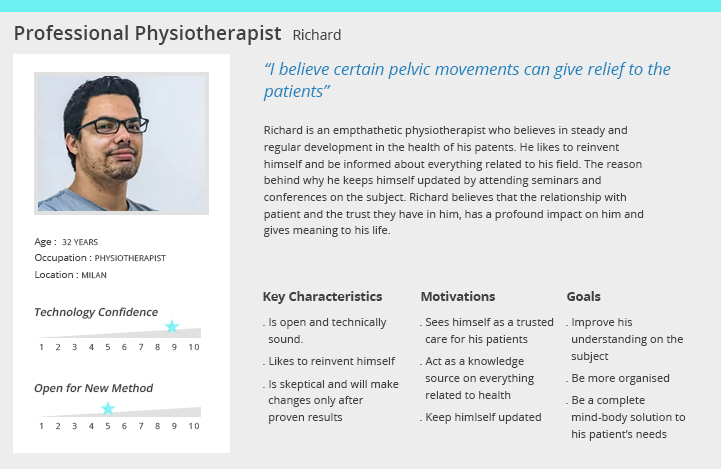
Insights gained guided my discovery phase

- Urinary incontinence is a much more common problem than most people realize.
- Pelvic dysfunction has a direct effect on human psychology and is a major cause of stress, anxiety, and depression.
-
Weak pelvic floor muscles can lead to urinary incontinence. Strengthening these muscles through targeted exercises helps support the bladder, bowel, and uterus, improving control and preventing incontinence.
-
Many comprehensive and non-surgical treatments are available for rehabilitation with little to no medication supplementation.
The Discovery
I observed that Wiethaler’s approach consistently produced remarkable outcomes, even in instances of severely contracted pelvises.
Instead of solely focusing on muscle exercises or movements,
- her method prioritized the integration of high-quality breathing techniques,
- precise synchronization of movements, and
- utilizes imagery and visualization methods to cultivate a holistic mind-body connection.

A Holistic Health Solution
Not just exercises, but a mind-body connection!
Why Weithaler Method is the solution?
The approach to treating urinary incontinence is highly personalized, contingent upon the specific type and severity of the condition.
Wiethaler’s method underscores this personalized aspect, tailoring treatment to each individual’s needs. It not only targets the physical aspect of strengthening the pelvic floor muscles but also integrates a holistic mind-body approach to address the root causes.
This method serves as an effective alternative to medication or surgery, either as a primary intervention or as post-operative support, rendering it applicable and beneficial across a broad spectrum of patients.
Design Strategy
The design strategy focused on creating a user-centered, accessible, and trustworthy digital experience that reflects the expertise of Veronika Weithaler and her holistic pelvic health method.
Ideation
Setting the Design Direction
By involving Veronika from the start, I ensured her insights shaped the process at every stage. Using the research findings and envisioned solutions, I began designing the user experience.

Wireframing
I began the design process by sketching workflows on paper to understand the information flow and identify opportunities to improve user engagement. Key decisions, like a one-scroll homepage and prominently featuring courses and books, were made to guide users effectively.
I also placed testimonial snippets strategically to encourage exploration and added a quick contact form for easy access. Rapid sketches of interface variations allowed me to iterate on layouts, refine content hierarchy, and optimize the overall user experience.
Branding and Design Styles
Given that incontinence is a deeply personal and often daunting issue, I opted for a color palette that exuded comfort and reassurance. Soft, soothing blues and greens were selected to evoke a sense of calm and serenity. Additionally, powerful imagery showcasing the method in action was incorporated to provide visual reassurance and instill confidence in visitors.
These colors also symbolize growth, renewal, and rejuvenation, reinforcing the message of empowerment and transformation inherent in the method.
Wiethaler personally demonstrated the movements of a healthy pelvic floor and how dysfunction presents. This informed my image selection for the website’s Method page.


Image treatment in Adobe Photoshop.
Professional photography was carried out for showcasing the precise movements
The Framework
Leveraging WordPress for site development allowed us to display different versions at various stages directly on the site, simplifying the process for both Veronika and myself.

Throughout the process, a series of deliberate design decisions were made to enhance the effectiveness and user-friendliness of the website. These decisions include:
Content Hooks Before Header: Strategically placed content hooks provide quick access to essential information such as the address, email, and contact number, ensuring users can easily locate pertinent details without navigating through multiple pages.
Sticky Header: Implementation of a sticky header ensures consistent branding and easy access to the menu, allowing users to navigate seamlessly throughout the website without losing sight of important navigation options.
Prominent Call-to-Action Buttons: Inclusion of prominent call-to-action buttons for actions such as ‘Take an Appointment’ and ‘The Method Page’ in the header encourages user interaction and guides visitors towards key conversion points.
Background Carousel: A background carousel featuring imagery of pelvic floor exercises was incorporated to visually engage visitors and highlight key aspects of Veronika’s method. This dynamic visual element captures attention and reinforces the core principles of the method, promoting further exploration and engagement.

The courses were prominently displayed so users could easily stay updated and book appointments. The clear presentation made it simple to navigate and find relevant information.

The ‘Published Books and DVDs’ section was meticulously crafted with a focus on establishing a trust-based system. Clear and prominent calls-to-action were strategically integrated, guiding visitors towards purchasing Veronika’s books and DVDs.

Additionally, reviews and testimonials were showcased to reinforce credibility and instill confidence in the quality of the products. Secure payment options and transparent shipping and return policies were also highlighted, further enhancing the trustworthiness of the system.

Following the testimonials, videos were prominently displayed in all three languages – Italian, English, and German, featuring Veronika herself explaining the intricacies of pelvic floor health. These videos provided valuable insights and expertise directly from Veronika, further building trust and credibility with the audience.

To streamline communication and provide quick access to information, simple contact forms were implemented. These forms allowed visitors to submit inquiries or requests directly through the website, facilitating efficient and convenient communication with Veronika and her team.
Multi-lingual setup

To ensure a systematic approach to multilingual website development, I initially set up the Italian language version as the foundation. Once this version was nearly complete, it served as a template for the remaining languages, namely German and English. WPML (WordPress Multilingual Plugin) was implemented to support multilingual functionality. Pages and posts were translated using WPML’s Translation Management workflow, and a language switcher was configured in the header to enable seamless navigation between language versions while maintaining consistent layouts.
The Method Page
A critical design decision emerged during this phase with the creation of a dedicated ‘method page’. This choice was pivotal as it was essential to comprehensively explain the primary aspect of Veronika’s practice on the website.

Male and female pelvis to help understand the movement and the dysfunction

Wiethaler’s method was the most important element of the website. It essentially set her apart from her competition and acted as her unique selling point against the pool of information available online. Once I started putting all the information together, I realised that the content about the method was extensive. It had to be coherently presented in order to create the trust and credibility that we were aiming for.
Appropriate images were important for clarity in description. We used available anatomical phantoms where possible and were also lucky to get help from companies who provided us free access to their proprietary images.
Impact & Feedback
Following the launch, the website showed steady growth in user engagement. Analytics indicate increased activity around the professional course periods between April and December each year.
The website recorded a,
20% increase in monthly visitors and a
52% rise in subscriptions from German clients
demonstrating improved discoverability and conversion among the target audience.

User types, and engagement from various regions
After introducing the Announcement Section above the main featured content, the website saw an increase in average monthly site visits.
Ongoing Design Support
Post-launch, I supported the client with additional communication materials including course posters, flyers, and digital updates. This ensured consistent promotion of upcoming courses and strengthened the connection between the website and offline outreach.
